×



Organises
on
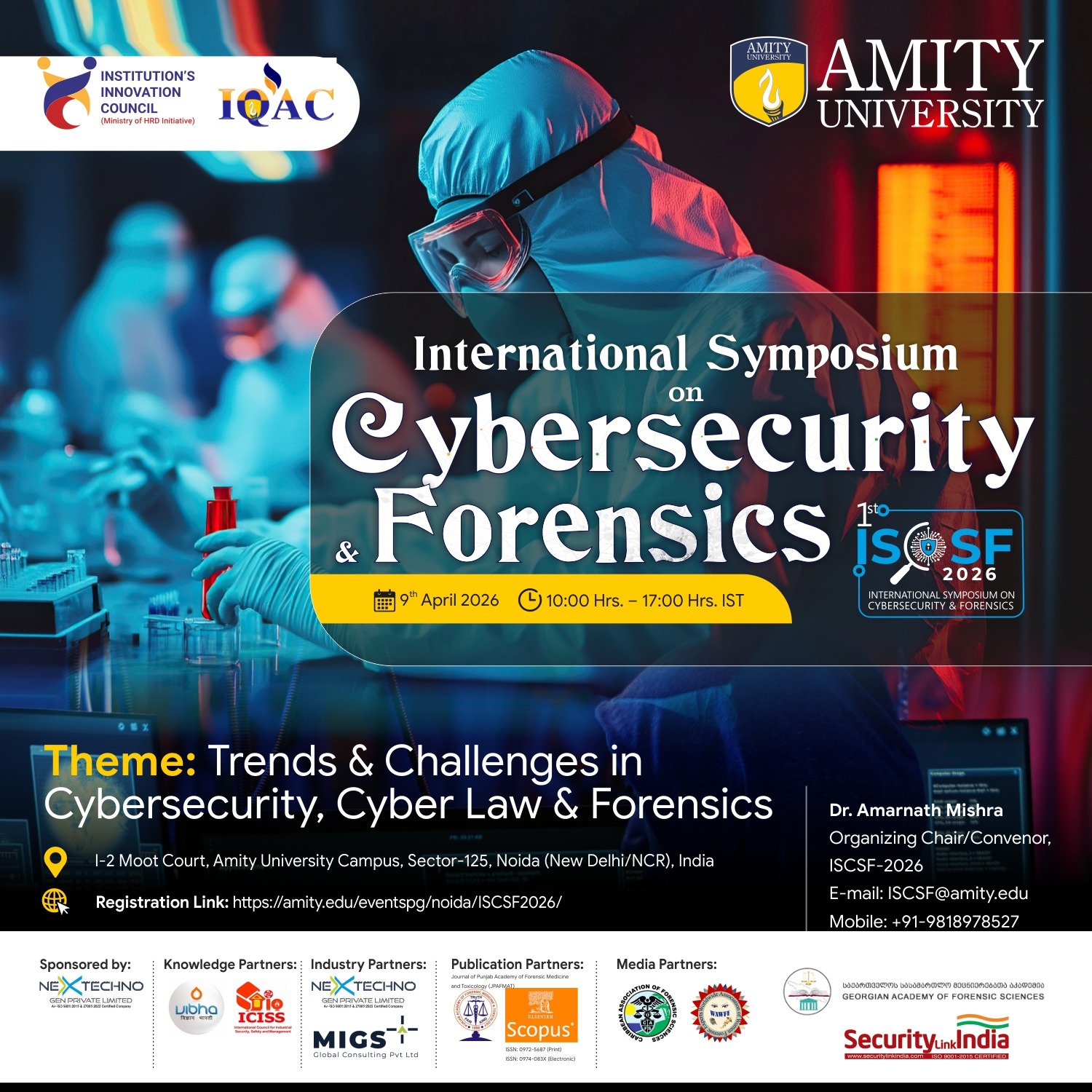
Theme: Trends & Challenges in Cybersecurity, Cyber Law & Forensics
Date: 9th April 2026
Time: 10:00 Hrs. – 17:00 Hrs. IST
Venue: F-2 Auditorium, Amity University Campus, Sector-125, Noida (New Delhi/NCR)
Amity University Uttar Pradesh is part of Amity Education Group which has been sponsored and promoted by Ritnand Balved Education Foundation (RBEF) has over 2,50,000 students studying across over 2000 acres of hi-tech campuses. Today Amity Education Group has 12 Universities, 28 schools and pre-schools, 13 global Campuses Over 2600 patents are filed by the Faculty, Scientists and Researchers. The faculty has 500+ collaborative funded projects from Government, Industry and International agencies. Amity Group has 8000+ Faculty including eminent Scientists with diverse disciplines. The 81 faculty of Amity Group are featured in the list of top 2% scientists in the world published by researchers of Stanford University for the Academic Year 2024-25. Amity University Uttar Pradesh has been accredited by WASC Senior College and University Commission (WSCUC), USA and Quality Assurance Agency for Higher Education (QAA), UK. Amity University Uttar Pradesh has been ranked 183 amongst the top Universities in ASIA by QS with QS (World) Ranking of 951-1000. The university Times Higher Education (THE) ranking THE (Asia) is 251-300 and THE (World) is 601-800. The NIRF University ranking of Amity University Uttar Pradesh in the year 2025 is 22 with NIRF Research ranking of 38 and NIRF Pharmacy ranking of 18 respectively.
Amity Institute of Forensic Sciences, Amity University Uttar Pradesh, Noida, India is a leading premier institute dedicated to nation service. It offers higher education in forensic sciences at three programmes levels: UG- B.Sc. (Forensic Sciences) (Honours / Research), PG- M.Sc. (Forensic Sciences) & M.Sc. (Cyber Forensic & Cyber Security) and Doctorate- Ph.D. (Forensic Sciences) in Full Time and Part Time. All the courses aim to instil in student’s professional acumen, skills and capabilities to deal with different areas of life.
Amity Institute of Forensic Sciences is an institute of Amity University came into existence by an act under the Amity University (Uttar Pradesh) Act, 2005 and it has also been listed under ‘Educational Institutions’ in the U.P. Govt. website (http://www.upgov.nic.in/). Its main aim is to conduct important professional courses that can ensure employment to passing-out students. In addition, several short-term training and capacity building programmes are being offered by the institute. The institute has organized National and International conferences, workshops, seminars, faculty development programs, refresher courses, value added courses and quiz competitions
The rapid digitization of society has brought unparalleled advancements in technology, connectivity, and access to information. However, these benefits come with an increasing prevalence of cyber threats, cybercrimes, and sophisticated attacks targeting individuals, organizations, and governments. In this digital age, cybersecurity, cyber law, and forensics play a pivotal role in safeguarding critical infrastructure, ensuring privacy, and maintaining the rule of law in society and cyberspace.
The International Symposium on Cybersecurity & Forensics aims to provide a multidisciplinary platform for professionals, researchers, academicians, policymakers, and industry experts to discuss cutting-edge developments, emerging trends, and pressing challenges within the fields of cybersecurity, cyber law, and forensics. Under the theme "Trends & Challenges in Cybersecurity, Cyber Law & Forensics", the symposium will facilitate thought-provoking discussions and foster collaboration to address these global issues effectively.
This symposium aligns with the goals of the United Nations Department of Economic and Social Affairs (UNDESA) and integrates principles of the Sustainable Development Goals (SDGs) specifically:
Rationale
Cybersecurity:
The complexity of cyber threats has grown exponentially, ranging from ransomware attacks and data breaches to Advanced Persistent Threats (APTs). Organizations are struggling to keep pace with attackers who constantly exploit vulnerabilities in systems, networks, and human behavior. Emerging technologies like Artificial Intelligence (AI), Internet of Things (IoT), and blockchain introduce both opportunities and risks, necessitating a comprehensive approach to cybersecurity.
Cyber Law:
Legal frameworks for cyberspace remain fragmented and inconsistent across jurisdictions. This poses challenges for cross-border cooperation in prosecuting cybercriminals and establishing global standards for data protection, privacy, and intellectual property rights. Moreover, new technologies often outpace the development of legislation, leaving critical legal gray areas. A robust understanding of cyber laws is essential to creating a safer and more predictable digital ecosystem.
Forensics:
Forensic Science has become indispensable in investigating different crimes including cybercrimes, identifying perpetrators, and collecting admissible evidence. However, the increasing volume and complexity of data, along with encryption technologies, pose significant challenges for forensic experts. Keeping forensic techniques up-to-date with evolving technologies and legal standards is critical to ensuring justice in the normal and digital realm.
The conference seeks to address these interconnected domains by uniting stakeholders to explore innovative solutions and strategies for a secure a crime free society and digital future.
This Symposium is primarily meant for, though not limited to:
Interested participants may submit their abstracts for poster presentation in suitable tracks including basic sciences/interdisciplinary subjects.
|
Track No. |
Main Tracks |
Sub-Tracks |
|
T01 |
Forensic Physical Sciences |
Forensic Physics | Forensic Ballistics | Questioned Documents | Dermatoglyphics | Forensic Acoustics | Multimedia Forensics | Audio Forensics | Physical Instrumentation | Physical Sensors |
|
T02 |
Forensic Chemical Sciences |
Forensic Chemistry | Forensic Toxicology | Explosives | Forensic Pharmacology | Cheminformatics | Chemical Instrumentation | Chemical Sensors | Chemical Security |
|
T03 |
Forensic Biological Sciences |
Forensic Biology | Forensic Anthropology | Wildlife Forensics | Forensic Entomology | DNA Fingerprinting | Bioinformatics | Biological Instrumentation | Biosensors | Bioterrorism |
|
T04 |
Computer Forensics |
Cyber Forensics | Digital Forensics | Mobile Forensics | Network Forensics | Artificial Intelligence | Machine Learning | Digital Security | Cyberterrorism |
|
T05 |
Crime Scene Investigation & Risk Management |
Crime Scene Investigation Method | Crime Scene Management | Financial Investigations | Data Analytics | Forensic Accounting | Forensic Auditing | Fraud Investigations |
|
T06 |
Forensic Medical Sciences |
Forensic Medicine | Forensic Pathology | Humanitarian Forensics | Sexual Jurisprudence/ Forensic Gynaecology | Forensic Psychiatry | Virtual Autopsy | Health Security | Sports Science & Medicine |
|
T07 |
Behavioural Sciences |
Criminology | Forensic Psychology | Polygraph | Narco-Test | Brain Mapping/Fingerprinting | Layered Voice Stress Analysis | Criminal Profiling | Cyber Psychology |
|
T08 |
National Security |
Homeland Security | Police Sciences | Industrial Security | Coastal and Maritime Security | Security Management | Security entrepreneurship | Border control | Human trafficking |
|
T09 |
Law & Justice |
Civil Jurisprudence | Criminal Jurisprudence | Juvenile Delinquency | Organised Crime | Crime against Women & Children | White Coller Crime |Cyber Crime | International Crime | Human Rights |
Key Highlights
We welcome abstract submissions for poster presentations aligned with the Symposium main tracks and sub-tracks
Selected full papers will be published as Research Article/ Review Paper/ Case Studies in the Journal of Punjab Academy of Forensic Medicine and Toxicology (JPAFMAT) (a SCOPUS-indexed journal; ISSN: 0972-5687(Print), 0974-083X(Electronic).
Engage with prominent experts, government officials, and industry leaders to share insights and develop actionable solutions for contemporary challenges in forensic science, national security & law.
For UG/PG Students and Research Scholars/ Post- Doctoral Fellows (National): 10 registrations on a 10% discount, 15 registrations on a 15% discount and 20 registrations on a 20% discount.
|
Abstract Submission Deadline |
31st March 2026 |
|
Notification for Acceptance of Abstract |
27th February 2026 onwards |
|
Early Registration Deadline |
1st April 2026 |
|
Late Registration |
8th April 2026 |
|
Full Length Paper Submission |
16th April 2026 |
|
On Spot Registration (for participation only) |
9th April 2026 |
**All submitted & presented abstracts will be included in the abstract book.
*Presented/ peer-reviewed/ selected full papers will be published in SCOPUS Indexed Journals or ISBN Indexed Book/Proceedings.
Registration Link: CLICK HERE
The registration fee for the Symposium includes a kit, lunch and high tea on date of the symposium.
|
S. No. |
Category |
National |
International |
||
|
Early Bird Registration (Till 1st April 2026) |
Late Registration (Till 8th April 2026) |
Early Bird Registration (Till 1st April 2026) |
Late Registration (Till 8th April 2026) |
||
|
1. |
Students (UG/PG) |
Rs. 750/- |
Rs. 1000/- |
$50 |
$75 |
|
2. |
Amity University Noida Campus Alumni |
||||
|
3. |
Research Scholars/ Post- Doctoral Fellows |
||||
|
4. |
Faculty/Scientist/Lawyers/ Judges/Industry Person/Other Professionals |
Rs. 1000/- |
Rs. 1500/- |
$100 |
$125 |
|
5. |
Accompanying person (one) |
Rs. 750/- |
Rs. 1000/- |
$25 |
|
|
6. |
On Spot Registration (9th April 2026) |
Rs. 2000/- |
$125 |
||
*NOTE: GST as applicable extra
Free Registration for Retired Professors/Scientist aged 65+ years (participation only)