The Brave Choice: Why Asking for Help is a Counselor’s Highest Form of Strength

By Ar. Poorva Priyadarshini
(Dept of Architecture and Planning) Amity University Haryana
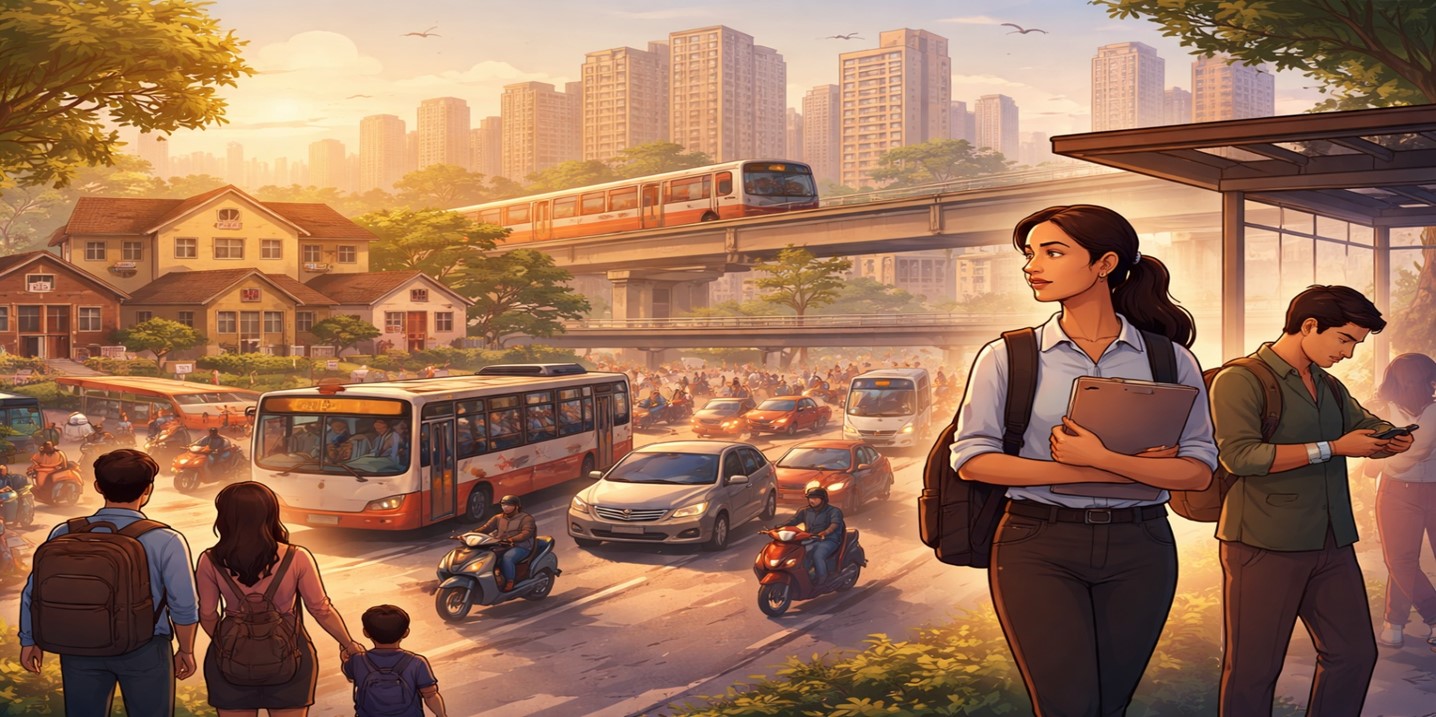
Introduction: Every morning, as the city begins to move, millions of people step out of their homes and begin a journey that silently shapes their lives. Some walk a few minutes to a nearby bus stop or metro station, while others travel for hours across the city, changing buses, trains, and roads before reaching their workplace or classroom. These daily journeys are rarely considered when we talk about housing affordability. Yet, they tell the real story of what it costs to live in a city. Housing is often labelled affordable when rent appears low, particularly in areas on the edge of cities. However, for those who live there, affordability is experienced through long commutes, rising fuel expenses, and lost hours of rest and family time. This paper explores housing affordability not as a static financial calculation but as a lived urban experience shaped by transportation cost.
When land prices rise in city centres,
affordable housing is pushed outward. At first glance, this shift seems
logical. Cheaper land allows cheaper housing, offering relief to households
struggling with high rents. However, as residents settle into these peripheral
areas, a new cost begins to emerge. Each kilometer between home and workplace
translates into money spent on travel and time lost in transit.
Transportation costs include more than bus
fares or fuel prices. They include the cost of owning and maintaining vehicles,
the stress of congestion, and the exhaustion of long commutes. For students and
teachers, these journeys often begin before sunrise and end late in the
evening, leaving little time for learning, reflection, or family life. What
appears affordable on paper slowly becomes unaffordable in practice.
Researchers began to recognize this
disconnect when households that met traditional affordability benchmarks
continued to experience financial strain. The Housing plus Transportation
affordability framework emerged from this realization, suggesting that housing
costs cannot be separated from mobility costs. A home is only truly affordable
when it allows people to reach their daily destinations without excessive
financial or physical burden.
In many cases, households living closer to
employment centres pay higher rent but spend significantly less on
transportation. Over time, their overall cost of living is lower than those
residing in distant suburbs. Affordability, therefore, becomes a question of
access rather than price alone. The form of the city itself plays a critical
role in this story. Cities that grow outward rather than upward create longer
distances between homes, jobs, and institutions. This pattern of urban sprawl
increases dependence on private vehicles and weakens public transport networks.
Residents living in such environments often have little choice but to spend
more on transportation, even when their incomes do not increase.
In contrast, compact and well-connected
neighbourhoods allow residents to walk, cycle, or use public transport with
ease. In these areas, daily life becomes less about surviving long commutes and
more about participating in the city. Accessibility transforms affordability.
Public transportation has the power to
rewrite the story of housing affordability. A reliable metro line or bus
corridor can shrink distances and reduce expenses. Homes located near transit
systems offer residents something more valuable than low rent: time,
predictability, and opportunity. Transit-oriented development reflects this
understanding by encouraging housing, workspaces, and services to grow together
around transport nodes. Such environments reduce travel costs, support
sustainable mobility, and create neighbourhoods where affordability is
experienced holistically rather than calculated narrowly.
The burden of transportation cost is not
shared equally. Low- and middle-income households feel it most acutely, as a
larger portion of their income is spent on commuting. Long travel times often
force difficult choices, such as reducing educational expenses, postponing
healthcare, or accepting informal housing closer to work.
These patterns are visible in Indian cities,
where informal settlements often appear near employment centres and educational
hubs. These settlements are not merely housing solutions; they are responses to
unaffordable transportation. They reveal how people prioritise proximity over
formal ownership when survival is at stake.
In Indian cities, the relationship between
transportation and housing affordability is deeply intertwined with rapid
urbanisation and uneven infrastructure development. Students and faculty
members often travel long distances due to limited affordable housing near
campuses. Rising fuel prices and overcrowded public transport further intensify
the burden.
These daily journeys, repeated year after
year, shape academic productivity, mental health, and quality of life. They
highlight the urgent need for planning approaches that consider housing and
transportation as parts of a single system rather than separate sectors.
Housing affordability is not just about the
cost of a roof over one’s head. It is about the cost of reaching the world
beyond that roof. Transportation cost quietly determines how much time people
have, how much energy they spend, and how fully they can participate in urban
life.
By listening to the everyday journeys of city
residents, this paper argues for a redefinition of affordability that places
accessibility at its core. Integrated land-use and transportation planning can
transform cities from spaces of daily struggle into environments of
opportunity. True affordability, ultimately, is not measured in square feet or
rent receipts, but in the ease with which people can live, learn, and belong.





Copyright © 2026 amity university | All rights reserved.