The Brave Choice: Why Asking for Help is a Counselor’s Highest Form of Strength

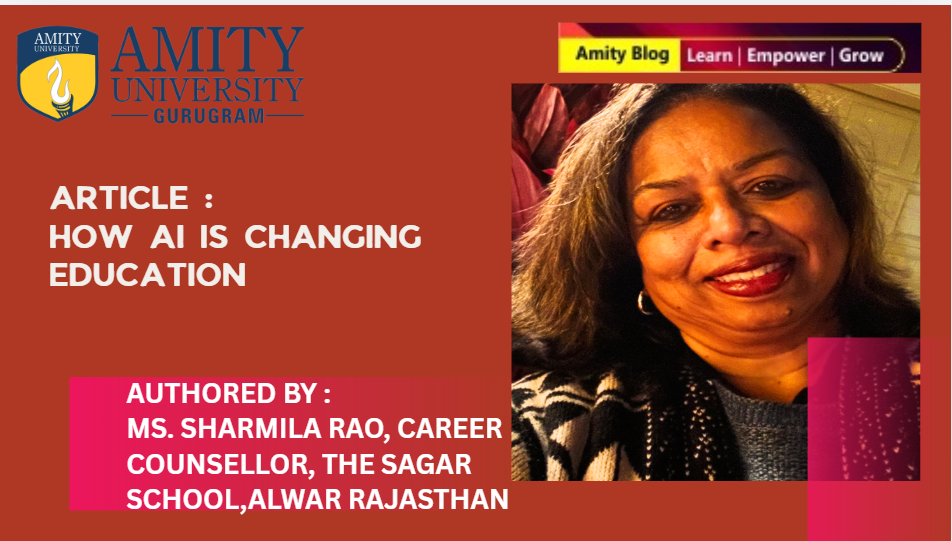
AI is reshaping what students need to learn and how educators design learning, shifting the focus from content recall to future-ready human and digital skills.
Schools that
integrate AI thoughtfully—both as a tool and as a topic—prepare learners to
work alongside intelligent systems rather than be displaced by them.
How AI is Changing Education
• AI enables personalized and adaptive learning pathways, adjusting content and
pace to each learner based on real-time performance data.
• Intelligent tutoring systems, chatbots, and automated feedback free teacher
time for higher-order instruction and mentoring.
• Learning analytics and predictive models help institutions identify
struggling students early and refine curricula using data-driven insights.
Core Digital & AI Literacies
• Students need strong digital literacy, including safe and effective
technology use, data literacy, and understanding algorithmic systems.
• AI literacy now includes concepts like how models work, bias and fairness in
data, limitations of AI, and basic skills such as prompt design and algorithmic
thinking.
• Frameworks such as the AI Literacy Framework (AILit) emphasize a
“skills-first, ethics-centered” approach to navigating an AI-integrated world.
Human “AI‑Proof” Skills
• Education must prioritize skills that machines cannot easily replicate:
critical thinking, creativity, complex problem‑solving, and emotional
intelligence.
• Collaboration, communication, ethical reasoning, and judgment become more
important as routine cognitive tasks are automated.
• Adaptability, resilience, and lifelong learning habits are essential as
nearly 40% of workforce skills are projected to change within a few years.
Teaching and Assessment Shifts
• Curriculum needs to integrate STEM foundations with cross‑disciplinary
projects that apply knowledge to novel, real‑world problems.
• Assessments must move beyond recall questions to tasks that require analysis,
design, creativity, and reflective self‑evaluation.
• Generative AI can be used in class to scaffold higher-order skills—e.g.,
critiquing AI outputs, improving prompts, and comparing human vs AI reasoning.
System & Policy Priorities
• Systems should provide clear guidance on safe and responsible AI use, including academic integrity, data privacy, and equity of access.
• Teacher professional development is crucial so educators can use AI tools
effectively and teach with/ about AI, not just around it.
• Policies increasingly call for embedding AI concepts and skills into
standards, teacher credentials, and institutional AI governance frameworks.



Copyright © 2026 amity university | All rights reserved.