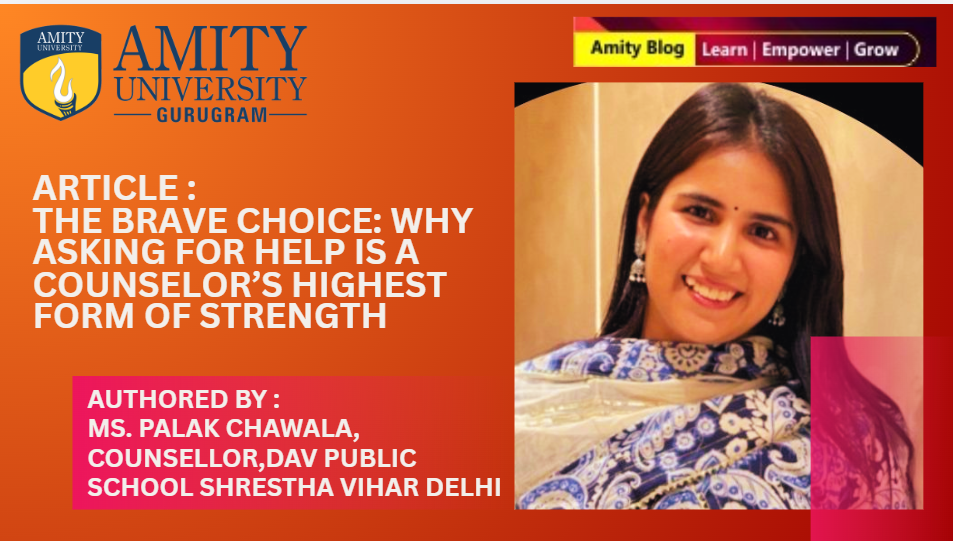
The Brave Choice: Why Asking for Help is a Counselor’s Highest Form of Strength

In today’s fast-paced world, students are navigating unprecedented academic pressures, social expectations, and the constant hum of digital life. Counseling is no longer just a support option — it is an essential foundation for cultivating resilience, self-awareness, and well-being. At Amity University, we believe every student’s mental health matters, and seeking help is a strength, not a weakness.
1. You Are Not Weak for Asking for Help
One of the most powerful myths we must dispel is that seeking help
shows weakness. In reality, asking for support is a profound act of courage.
Every day, students face challenges — academic stress, personal
doubts, social pressures, or emotional struggles. These experiences do not make
you inadequate; they make you human.
Why Asking for Help Is Strength
· It shows self-awareness: Recognizing when you need support
demonstrates emotional intelligence.
· It builds resilience: Reaching out helps you learn new coping
strategies.
· It fosters connection: Shared struggles lead to empathy and
community.
· It prevents escalation: Early support can stop issues from
growing into serious concerns.
Even the strongest athletes rely on coaches. Similarly, the
strongest minds use counselors, mentors, and trusted guides to navigate life’s
challenges. Support is not a last resort — it is a resource for growth.
Counseling Is Empowering
Counseling at Amity is confidential, student-centric, and tailored
to your journey. Whether you are struggling with stress, relationships,
motivation, or identity, our trained counselors offer a safe space to explore,
reflect, and renew your strength.
---
2. Dealing with Comparison in the Age of Social Media
Social media is a powerful tool — for learning, networking, and
creativity. But it also creates an environment of constant comparison: “Why
aren’t my achievements like theirs?” “Why do they seem happier than me?”
This cycle of comparison often leaves students feeling inadequate
or unseen.
Understanding the Nature of Social Comparison
· Highlight reels vs. real life: Social profiles showcase
accomplishments, not struggles.
· Curated perfection: Likes, followers, and polished stories
create unrealistic benchmarks.
· Emotional impact: Comparison can lead to anxiety, low
self-esteem, and isolation.
Strategies to Break the Comparison Trap
1. Practice Self-Compassion
Treat yourself with the same kindness you would offer a friend.
Your worth isn’t measured by another person’s post.
2. Set Personalized Goals
Your journey is unique. Focus on your interests, values, and
progress — not someone else’s highlights.
3. Curate Your Feed
Follow people who inspire, educate, and uplift. Remove accounts
that trigger negative self-judgment.
4. Take Digital Breaks
Unplug intentionally. Time away from screens supports clarity,
presence, and self-reflection.
5. Celebrate Small Wins
Every step forward — academic or personal — matters. Recognize it, journal it, and acknowledge your growth.
In Conclusion
Well-being is not a destination — it is a practice. It begins with
the choice to ask for help, seek support without shame, and navigate life with
awareness and compassion. In an age dominated by social comparison, we must
remind ourselves that every story is deeper than the snapshot.
At Amity University, we stand with you — encouraging resilience,
fostering community, and nurturing well-being for every student.
You matter. Your well-being matters. And together, we can build a
healthier, more mindful future.


Copyright © 2026 amity university | All rights reserved.